
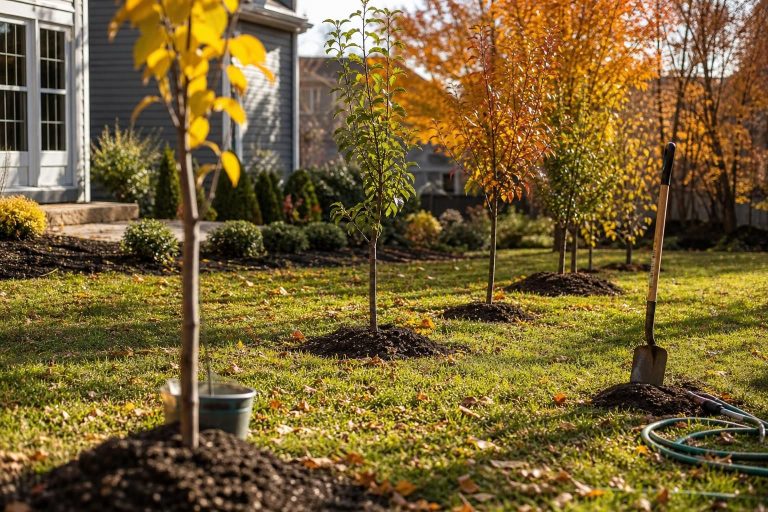
Autumn is often an excellent time to plant fruit trees in many US regions because the soil is still warm, rainfall is usually more reliable than in midsummer, and the tree can spend months growing roots before spring growth starts. If your ground is workable, not waterlogged, and your winter usually does not freeze the soil solid right after planting, fall planting can give backyard fruit trees a strong head start.
For a productive garden, the best fruit trees to consider for autumn orchard planting are apples, pears, plums, cherries, figs, and peaches, but only when they match your USDA hardiness zone, winter chill, and pollination needs. Before you buy, check four things: your zone, the tree’s chill-hour requirement, whether it needs a pollination partner, and mature spacing. Also ask local nurseries whether bare-root trees will arrive during dormant season or whether container trees are available now.
Why fall planting works so well for many fruit trees
When you plant in fall, the tree does not have to divide its energy between pushing lots of top growth and recovering from transplant stress in summer heat. Root growth continues while soil temperatures stay above freezing, even after leaves drop on deciduous trees. That means a tree planted in October or November in many parts of the US often enters spring better anchored and more ready to grow than the same tree planted late in spring.
Good candidates for fall planting are dormant bare-root trees and healthy container-grown trees with moist, not circling, roots. Bare-root trees are commonly sold during dormancy, while container trees may be easier to find at garden centers in early fall. If your area has very severe winters, drying winds, or repeated heaving from freeze-thaw cycles, container trees planted early in fall usually establish more safely than very late plantings.
A simple timing marker: aim to plant about 4 to 6 weeks before your ground typically freezes hard. If daytime temperatures are mostly cool, the tree has dropped leaves or is slowing down, and the soil still crumbles when you dig, planting conditions are usually good.
Apple and pear trees for broad adaptability
Apples are among the most practical backyard fruit trees for a productive garden because there are choices for many climates. Most apple trees need winter chill, and many need cross-pollination from a different apple variety that blooms at about the same time. A few are self-fruitful, but even those often crop better with a pollination partner nearby.
Plan on spacing dwarf apples about 8 to 10 feet [2.4 to 3 m] apart, semi-dwarf apples about 12 to 15 feet [3.7 to 4.6 m], and standard apples about 18 to 25 feet [5.5 to 7.6 m]. Pears usually need similar or slightly wider spacing depending on rootstock. If you plant too close, the canopies fill in, airflow drops, pruning becomes harder, and fruit quality usually declines.
Pears are also strong candidates for autumn orchard planting. European pears generally need chill and often benefit from cross-pollination, while some Asian pears can be partially self-fruitful but still produce better with another compatible tree. The key mistake here is assuming one tree is enough. Read the tag carefully for pollination notes before planting.
For both apples and pears, avoid low pockets where cold air settles. Spring frost lingers longer there, which can damage blossoms. A gentle slope or a level site with good air movement is better than the lowest point in the yard.
Plums and cherries where spring frost is less punishing
Plums can be productive backyard fruit trees, but pollination rules vary. Some European plums are self-fruitful, while many Japanese plums need another compatible variety. That makes them a good choice only if you are willing to plant more than one tree or already have a compatible plum nearby. Standard spacing often falls around 12 to 20 feet [3.7 to 6 m], depending on rootstock and variety vigor.
Cherries need more careful site planning. Sweet cherries often need cross-pollination and do best where spring weather is not too erratic during bloom. Sour cherries are more often self-fruitful and can be easier for a home grower. Space dwarf trees about 8 to 12 feet [2.4 to 3.7 m] apart and larger trees 15 to 20 feet [4.6 to 6 m] apart.
The biggest fall-planting mistake with plums and cherries is choosing them for a site that stays wet in winter. These trees strongly prefer well-drained soil. Test your drainage before planting: dig a hole about 12 inches deep and 12 inches wide [30 by 30 cm], fill it with water, let it drain once, then refill it. If water is still standing after about 12 hours, the spot drains too slowly for most fruit trees.
Peaches and figs for warmer or more protected gardens
Peaches are excellent if your climate provides enough chill hours in winter but not too much late frost during bloom. Many peaches are self-fruitful, which makes planning easier than with apples or plums. Even so, they need the right winter pattern. Too few chill hours can mean weak flowering; warm spells followed by frost can damage open blossoms.
Give peaches about 12 to 18 feet [3.7 to 5.5 m] of spacing, depending on rootstock and pruning style. Planting them in fall works best in regions with moderate winters. In colder areas, plant as early in fall as possible so roots can establish before hard freezes, and protect the trunk from winter sunscald and animal damage.
Figs suit warmer zones best and are especially useful where winter temperatures do not regularly kill top growth. They are usually self-fruitful, so one tree can often produce on its own. Space them roughly 10 to 15 feet [3 to 4.6 m] apart, or more if you want full-sized plants. In areas near the edge of their hardiness, plant figs in a sheltered south- or west-facing spot with winter wind protection and mulch the root zone after the soil cools.
The common mistake with peaches and figs is choosing a variety that matches a catalog photo but not the local climate. For peaches, verify chill-hour range. For figs, verify winter hardiness for your zone and whether dieback is common where you live.
How to choose bare-root trees or container trees in fall
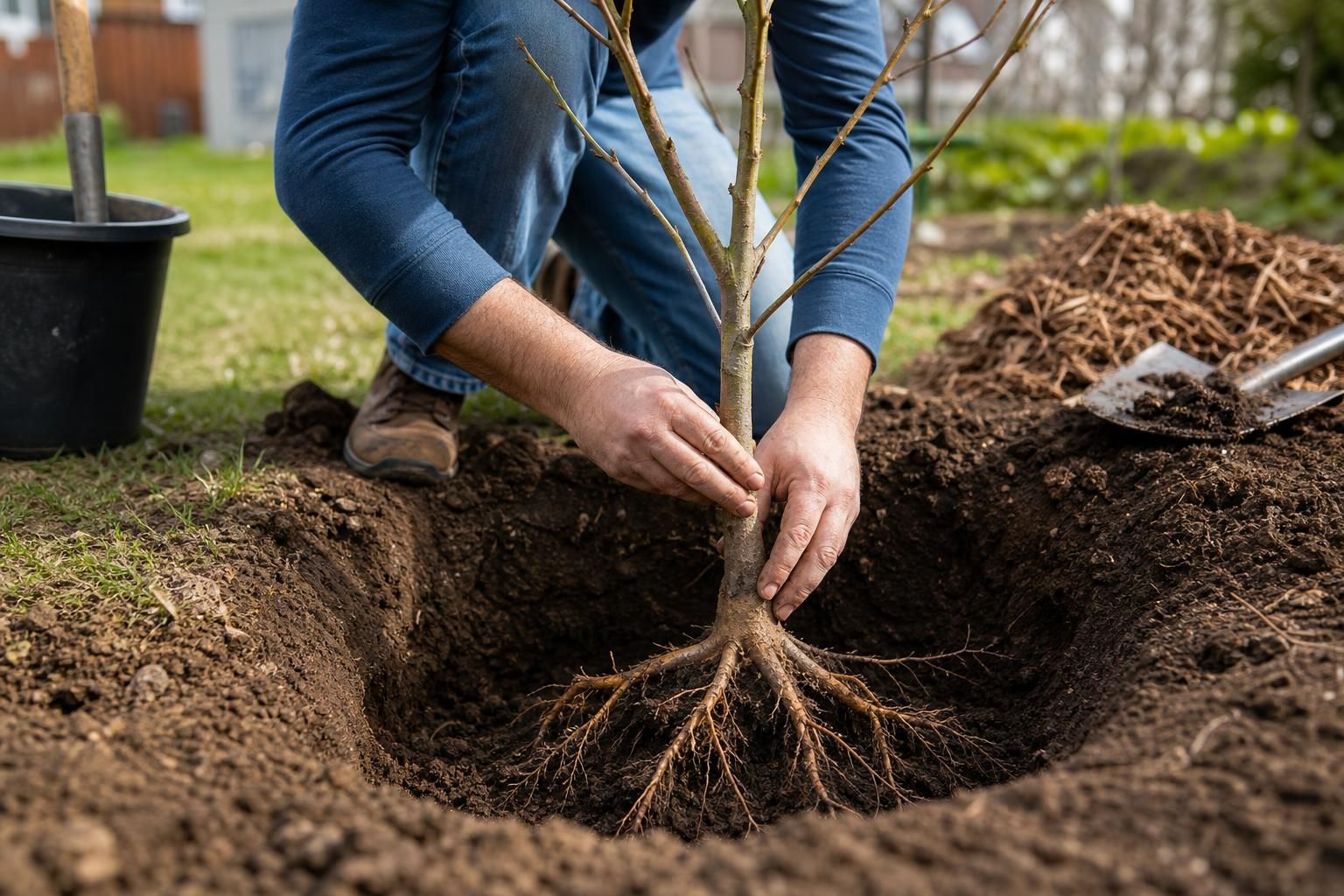
Bare-root trees are often the most economical choice and are easy to inspect because you can see the root structure clearly. Look for several firm, well-branched roots and no black, mushy, or shriveled sections. Plant bare-root stock while fully dormant, and soak the roots in plain water for 1 to 2 hours before planting if they seem dry. Do not leave roots soaking overnight.
Container trees can be planted in fall too, especially if local nurseries still have good inventory. Slide the tree from the pot and check for dense circling roots. If roots are winding around the outer root ball, tease them apart with your fingers or make 3 to 4 shallow vertical cuts, about 1/2 inch [1.3 cm] deep, around the sides before planting.
Whether bare-root or container-grown, set the tree so the root flare sits just above the finished soil line. The root flare is where the trunk widens at the base. If that flare ends up buried, the tree is planted too deep. That is one of the most common reasons young fruit trees struggle.
A practical fall planting checklist for a healthy start
Start with a hole no deeper than the root system and about 2 to 3 times as wide. Roughen the sides of the hole with your shovel. Set the tree on firm soil, spread roots outward, and backfill with the native soil you removed. Do not create a bowl of rich potting mix inside the planting hole; roots need to move into the surrounding ground.
- Drainage: Plant only where water drains well. If the planting hole becomes a pond after rain, choose a different site or build a broad mound 8 to 12 inches high [20 to 30 cm].
- Watering right after planting: Water slowly and deeply until the root zone is fully settled. A good starting point is about 2 to 5 gallons [7.5 to 19 L] for a small bare-root tree and 5 to 10 gallons [19 to 38 L] for a larger container tree, applied in stages so it soaks in rather than runs off.
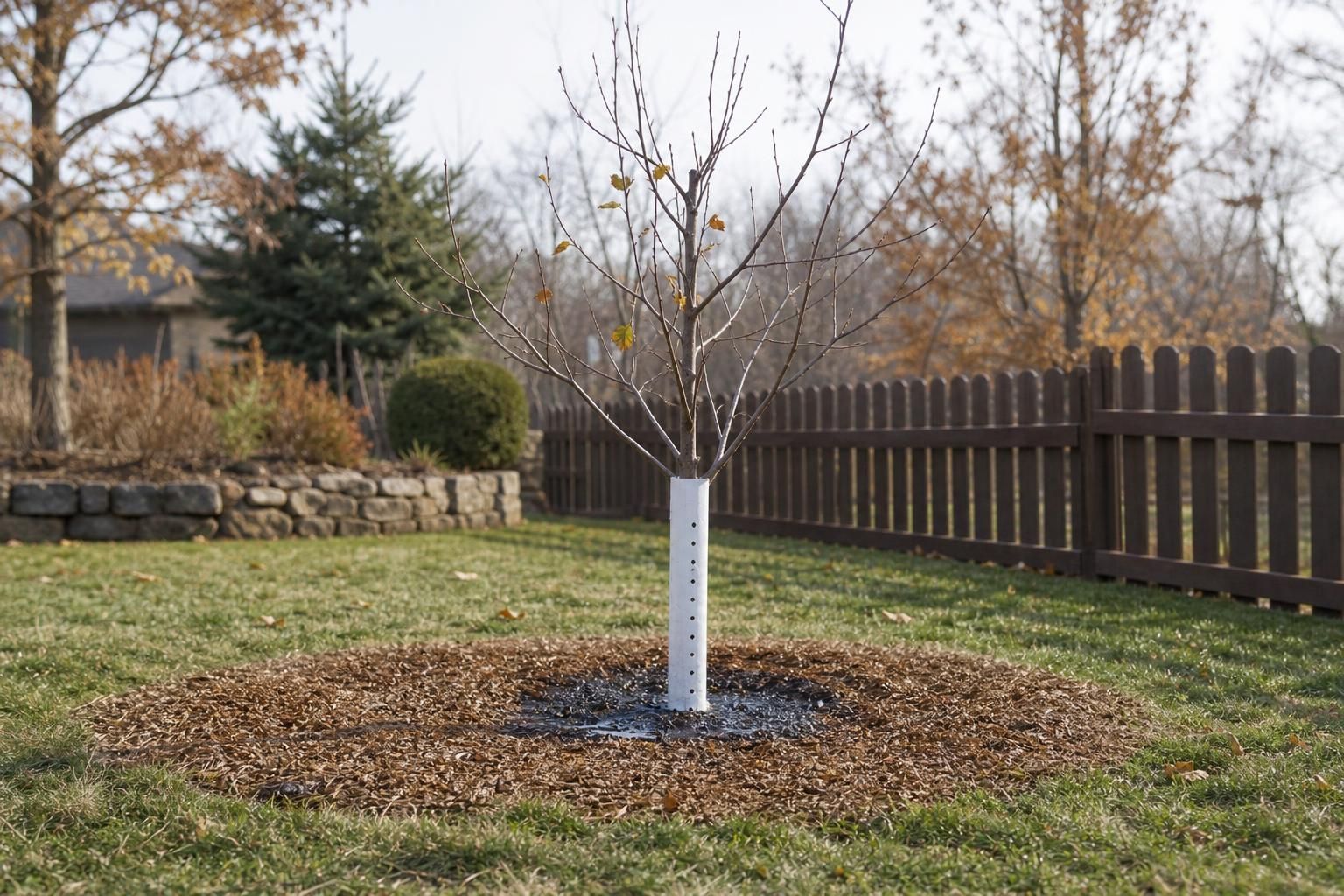
- Mulch: Add a 2- to 3-inch [5 to 7.5 cm] layer of wood chips or shredded leaves over the root zone, but keep mulch 3 to 4 inches [7.5 to 10 cm] away from the trunk. Mulch touching the bark holds moisture against it and invites damage.
- Watering through fall and winter: If rain is light, check soil moisture once a week. Push your finger 3 to 4 inches [7.5 to 10 cm] into the soil. If it feels dry at that depth, water deeply. If it feels cool and moist, wait.
- Trunk protection: In colder regions, use a white tree guard or trunk wrap for winter protection, especially on young apples, pears, and peaches. This helps reduce bark injury from sunscald and can also deter gnawing animals.
- Staking: Stake only if the site is windy or the root ball is unstable. Remove stakes after the first full growing season so the trunk can strengthen naturally.
As you plant fruit trees in fall, keep your focus on fit rather than variety names alone: USDA zone, chill hours, bloom timing, pollination needs, drainage, and mature size. If those five pieces line up, autumn orchard planting can set up a healthier root system and a more productive garden by next season and beyond.
Read also
- 🌸 Flowers That Bloom in Autumn (and Keep Your Garden Alive! ) 🍁
- The Most Resilient Fruit Trees for Your Garden: Cold, Pest, and Disease Resistance
- How to grow fruit trees at home