
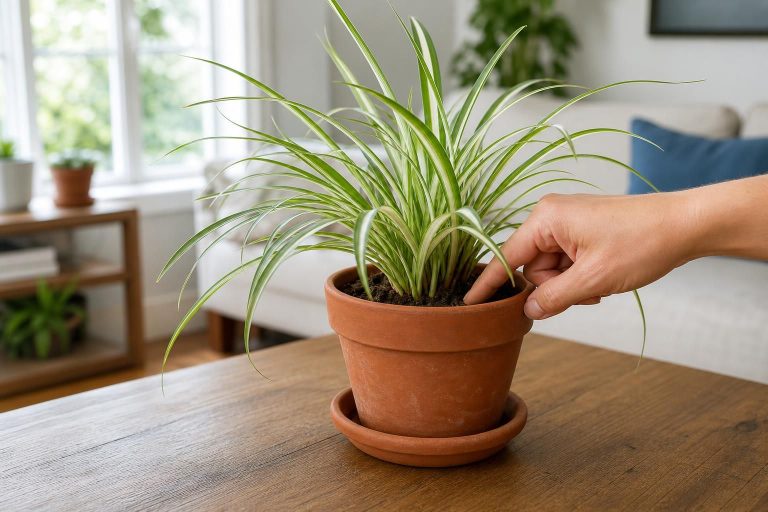
A spider plant does best when you stop watering by the calendar and start watering by what the plant and soil are showing you. The practical rule is simple: water when the top 1 to 2 inches [2.5 to 5 cm] of soil feel dry, the pot feels noticeably lighter when you lift it, and the leaves no longer feel quite as firm as they did right after a thorough watering.
For many homes, that means roughly every 5 to 10 days in brighter, warmer conditions and more like every 10 to 21 days in winter or lower light, but those ranges only help if you also check the soil first. A spider plant in a small terracotta pot near a bright window may dry much faster than one in a larger plastic pot across the room, so the best schedule is always the one the soil confirms.
Check these three signs before you water
If you want consistent spider plant watering, use the same quick check each time instead of picking a set weekday.
- Soil dryness: Press a finger into the potting mix 1 to 2 inches [2.5 to 5 cm] deep. If that layer feels dry and loose rather than cool and damp, it is usually time to water. If it still feels moist, wait another 2 to 3 days and check again.
- Pot weight: Lift the pot right after a full watering so you know its heavy, freshly watered feel. Then lift it again every few days. A spider plant that needs water is often much lighter than it was right after watering.
- Leaf feel and posture: Healthy leaves usually feel firm and arch cleanly. If they start to feel a bit softer, less crisp, or slightly droopy, check the soil right away. Soft leaves plus dry soil point to thirst. Soft leaves plus wet soil point to too much water around the roots.
When you do water, soak the soil until water runs from the drainage holes. For a small tabletop pot, that may be around 1 to 2 cups [240 to 475 mL]. For a medium 8-inch [20 cm] pot, it may be closer to 3 to 5 cups [700 mL to 1.2 L]. The exact amount matters less than the result: the entire root ball should be moistened, and extra water should drain out within a few minutes.
How the season changes your watering routine
Spider plants usually drink more in spring and summer, especially in bright indirect light and homes with air conditioning that keeps the air moving. During active growth, check the soil every 4 to 5 days, even if you do not end up watering that often.
In fall and winter, growth slows and the soil stays damp longer. In many US homes, that means checking every 7 days is enough, with actual watering often spaced farther apart. If your plant sits near a cold window, the mix may stay wet much longer than expected. If it sits near a heating vent, the top layer can dry fast while the lower half stays moist, so always check down to that 1 to 2 inch [2.5 to 5 cm] depth instead of judging by the surface alone.
Current season matters indoors too. In late summer and early fall, many homes are still warm enough for faster drying. In midwinter, especially in cooler rooms under 70 F [21 C], you may need much less frequent houseplant watering than you needed a few months earlier.
Pot material and pot size make a real difference
Terracotta pots pull moisture out of the soil and let it evaporate through the sides, so spider plant watering usually needs to happen sooner in terracotta than in plastic or glazed ceramic. If you move the same plant from plastic into terracotta, expect to check it more often right away.
Pot size changes things too. A small 4- to 6-inch [10 to 15 cm] pot dries faster than a deeper 8- to 10-inch [20 to 25 cm] pot, especially in a bright room. A root-bound spider plant can also use water quickly, since there is less loose soil left to hold moisture.
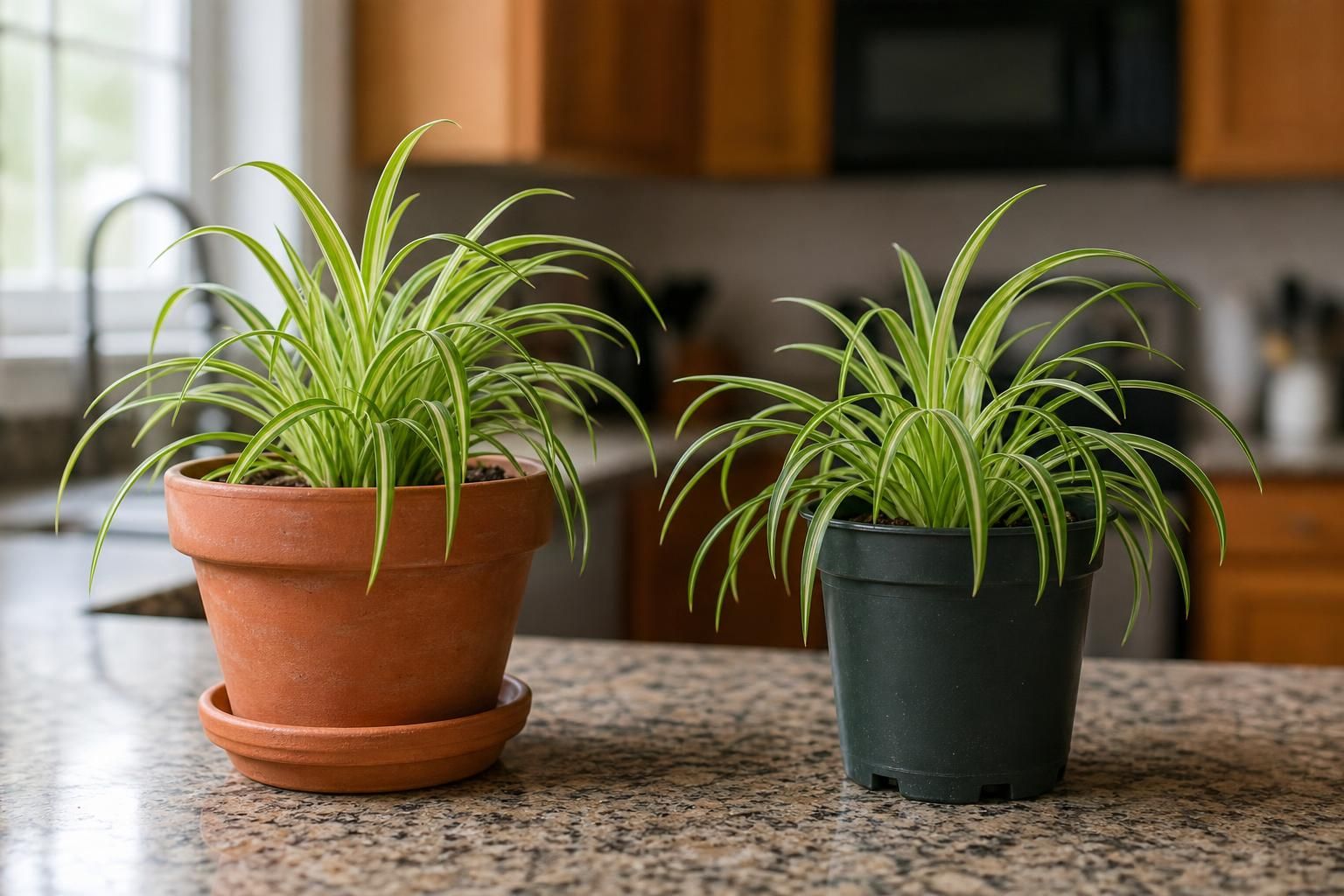
To make this practical:
- Small terracotta pot in bright indirect light: check every 3 to 4 days.
- Medium plastic pot in average indoor light: check every 5 to 7 days.
- Larger pot in winter or lower light: check every 7 to 10 days.
These are check intervals, not automatic watering intervals. If the soil is still damp at finger depth, wait.
What overwatering looks like before root trouble gets worse
Overwatering does not just mean giving too much water at one time. More often, it means watering again before the soil has used what is already there. A spider plant in very low light is especially at risk if it gets watered on a fixed weekly schedule.
Watch for these signs:
- Leaves turning pale or yellow, especially older leaves near the base
- Drooping even though the soil feels wet
- Soil staying damp for more than a week in warm conditions
- A pot that feels heavy day after day
- A sour or stale smell from the potting mix
If you notice this pattern, pause watering until the top 1 to 2 inches [2.5 to 5 cm] dry out. Empty any saucer within about 10 minutes after watering so roots are not sitting in runoff. If the plant is in a pot without drainage, move it into one with drainage holes as soon as you can. That change matters more for long-term Chlorophytum care than any exact watering day.
If the soil has become dense and stays wet too long, repot into a loose indoor potting mix and choose a container only about 1 to 2 inches [2.5 to 5 cm] wider than the root ball. Oversized pots hold extra moisture longer than a spider plant needs.
What underwatering looks like and how to correct it
Underwatering usually shows up first as dry, tired-looking foliage. The leaves may lose firmness, the tips may crisp more quickly, and the soil may pull away from the inside edge of the pot.
- Dry top 2 inches [5 cm] and limp leaves: water thoroughly until excess drains out.
- Soil shrunk from the pot edges: water slowly in two rounds, waiting 5 minutes between rounds so the mix can absorb moisture instead of letting it race down the sides.
- Very dry root ball that sheds water: set the pot in a bowl or sink with 1 to 2 inches [2.5 to 5 cm] of water for about 15 to 20 minutes, then lift it out and let it drain fully.
Brown tips can happen after periods of uneven moisture, where the plant gets very dry and then very wet. Keeping a steadier watering pattern helps. So does flushing the pot every month or so by watering deeply until plenty of water drains out, which helps wash out built-up minerals from normal watering and fertilizer use.
Simple indoor plant tips that keep watering on track
The easiest way to improve spider plant care is to match watering to light. A plant a few feet from a bright window will usually use water faster than one in a dim hallway. If your spider plant is in very low light, reduce watering frequency and expect the soil to stay moist longer.
Other useful habits:
- Water in the sink, tub, or over a tray where you can let the pot drain fully.
- Never leave the pot standing in a full saucer for hours.
- Use your finger and pot weight together, not either one alone.
- Rotate the plant every week or two so growth stays even, then keep checking moisture from the same side of the pot for consistency.
- If your home is warm, dry, and bright, check more often. If it is cool and dim, slow down.
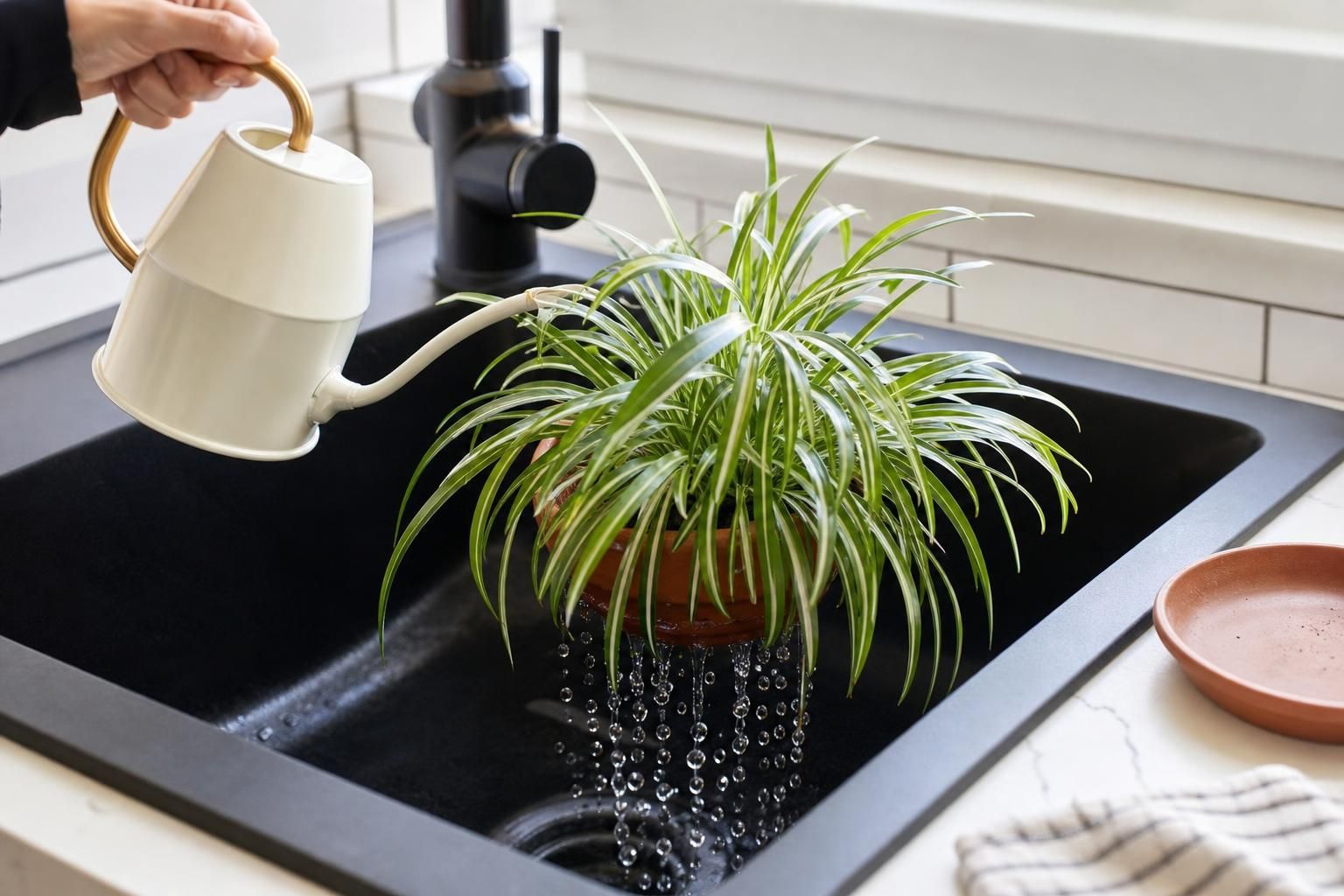
If you want one dependable rule to remember, make it this: do not water your spider plant because the calendar says so. Water when the top 1 to 2 inches [2.5 to 5 cm] are dry, the pot feels lighter than it did after the last soaking, and the leaves are just starting to ask for a drink without going limp for days. That approach keeps roots healthier, leaves firmer, and watering mistakes much easier to catch early.